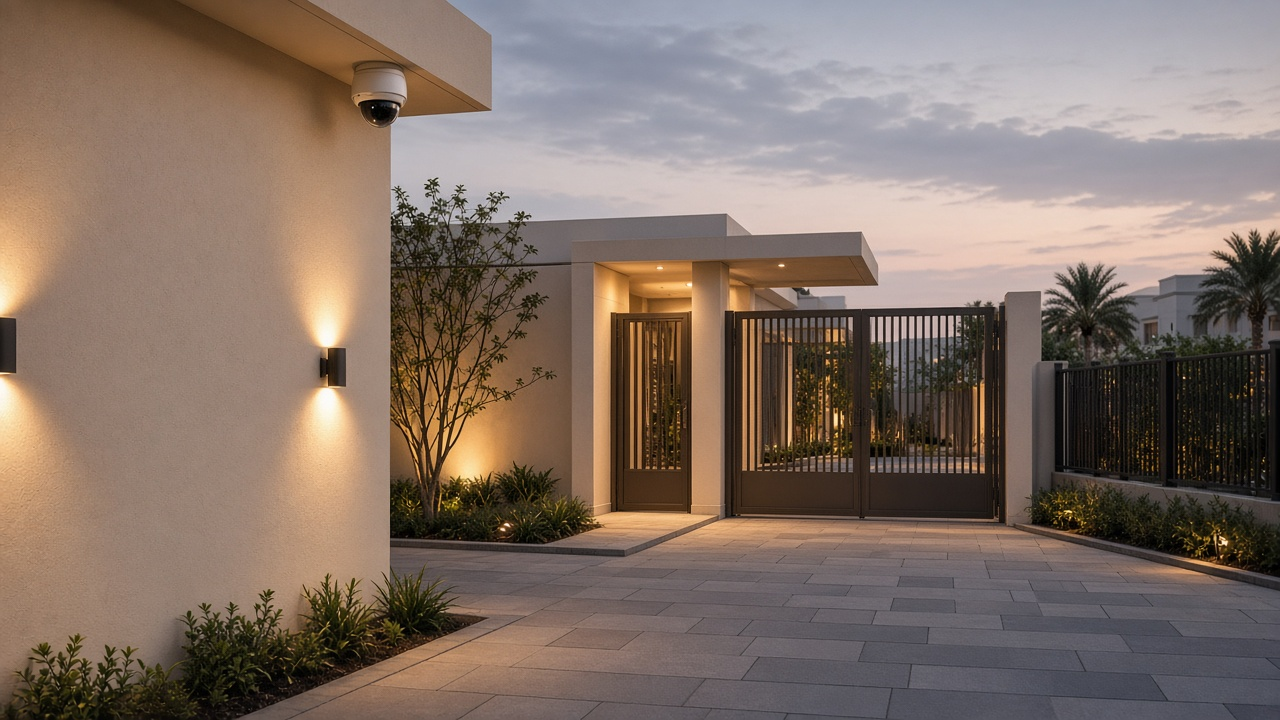
Daytime footage looks crisp. Then night falls, the driveway turns into a soft wash, faces lose their edges and number plates become white rectangles. The instinct is to buy a higher-megapixel camera and assume the night clips will sort themselves out. Megapixels help when there is plenty of light. They do not change the fundamental trade-off between exposure time, gain and motion.
This guide focuses on usable night evidence: people and vehicles moving through the scene under your actual lighting. Placement still matters; our villa camera placement post covers entrances and coverage angles. Storage options are set out in NVR, cloud or NAS. Here we stick to why the night image fails and how to test it properly.
Key takeaways
- A still night scene can look excellent while moving people and vehicles come out blurred. Test with the motion you actually expect, not a parked car.
- A longer exposure (the time the shutter stays open) gathers more light, but moving objects blur. Higher gain (turning up the camera's amplification) brightens the image but adds noise (a grainy look). More megapixels alone will not fix that.
- IR glare (a white fog or halo from the camera's infrared light) can come from nearby walls, glass, dirty domes, water droplets and spider webs, and it may only appear after the camera switches to night mode.
- Detection (spotting someone at the gate), recognition (identifying a person at the door) and plate capture (reading a number plate) are different jobs. If you need readable plates, test that as its own task rather than relying on an overview camera.
- SIRA rules (Dubai's security-system requirements) depend on the type of property and how it is used. The villa-complex chapter in the manual covers a group of residential villas, which is a different matter from a blanket rule for every private home.
- Separate image faults (blur, glare, soft focus) from missing frames (gaps in the recording) caused by power, network or storage problems.
Why sharp by day becomes soft at night
Axis's image-quality guide explains the core trade-off plainly. Shutter speed is exposure time. A slower shutter collects more light, which helps in the dark, but moving objects smear. Gain amplifies a weak signal and the noise along with it. Noise lowers quality and can push stream bandwidth up.
Wide dynamic range (WDR) helps when one part of the frame is bright and another is dark. It can also introduce motion artefacts, ghosting or banding. A WDR figure on a datasheet does not guarantee that a moving face or plate will be readable in your driveway.
A parked car under a still night setting can look fine. A person walking past, or a car rolling through the gate with headlights on, is a different test entirely. Axis recommends checking expected motion in the lighting conditions you actually need. That is the basis for a recorded night walk or drive test, done with the subject's consent.
Our placement guide already flags Dubai sunlight, reflective glass and stone, night lighting and heat. Combine that local context with the manufacturer guidance above. There is no supported figure here for summer failure rates or a fixed cleaning interval.
IR glare, reflections and Dubai villa surfaces
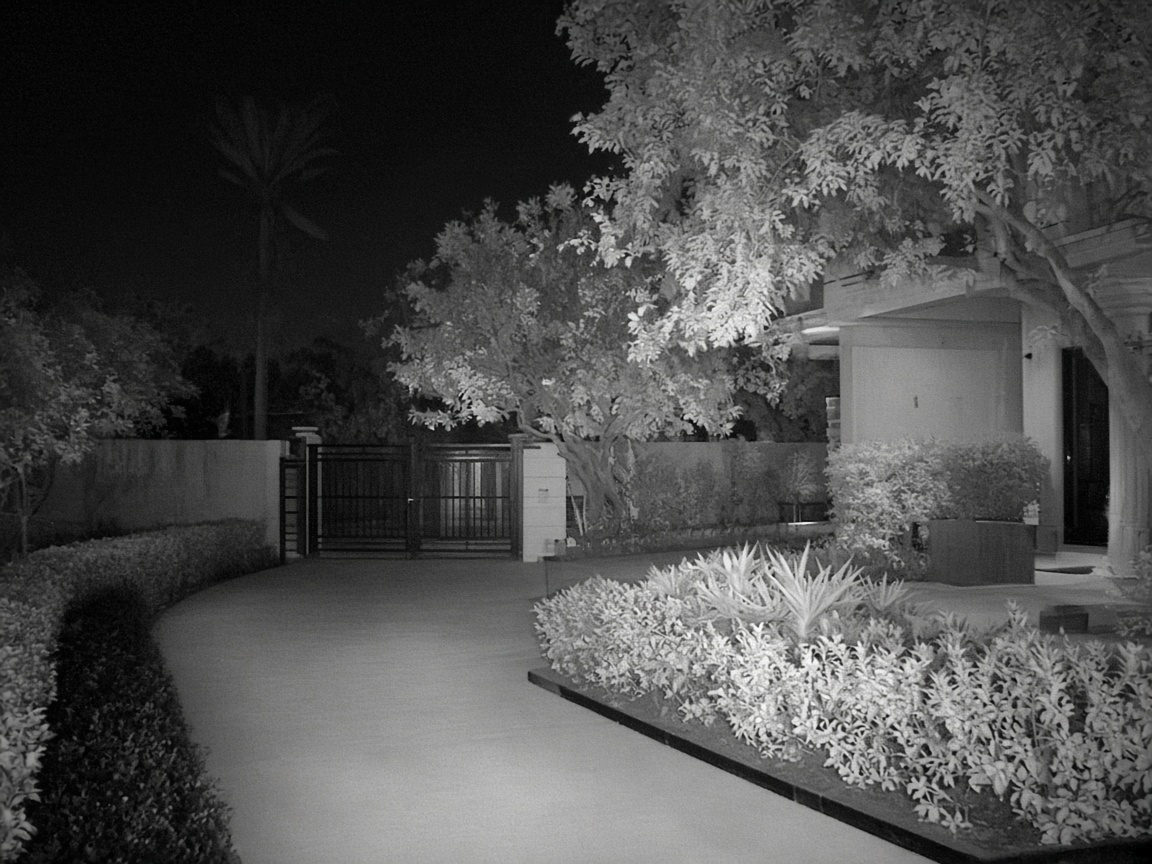
Infrared can look clean in the live view by day and fail the moment the camera switches to night mode. Axis notes that IR reflections may only appear then. Nearby walls, ceilings and windows, external lights, water, dust and webs are common causes. Dome cameras are especially prone when the dome is dirty or the illuminator reflects inside the housing. Axis covers this in its IR reflections white paper as well as the image-quality guide.
Before you replace a camera, check aim, dome cleanliness and whether the illuminator is bouncing off a gate, glass balustrade or light-coloured wall. Follow the manufacturer's cleaning instructions. Repositioning or improving scene lighting sometimes does more than a new sensor.
Consider sun direction for outdoor positions too. Optimising only for one moment of the day is how you end up with a great midday still and a useless dusk clip. Day and night tests both matter.
Faces, vehicles and number plates are different tasks
Recording goals are not interchangeable. A camera that detects someone at the gate may not identify a face. A camera that shows a car shape may not read a plate. Specialist plate capture usually needs its own lane, angle, illumination, shutter behaviour and lens choices. No universal claim about 4K cameras reading plates at a fixed distance holds true here.
If plate reading is essential, treat it as a distinct assessment. An overview dome over the courtyard is the wrong proof point. The distinction between a general CCTV view and dedicated plate capture is well established; our focus stays on household night faults and modest claims, not unsupported accuracy figures.
Agree the task before you change settings: detection at the gate, recognition of a person at the door, or a readable plate on the way in. Then test that specific task. Mixing the three in one sentence is how people buy the wrong upgrade.
A night acceptance test worth running
Run a short, recorded sequence yourself. This is a recommended homeowner workflow, not a Hurst First visit, package or service-level commitment. We do not offer after-dark testing:
- Agree the task and the target location (gate, door, driveway lane).
- Check privacy masks and viewing boundaries first.
- Use a consenting test subject moving normally through the area.
- Test under normal night lighting, and again with headlights or door lights where those matter.
- Replay and export the recording, not only the live view.
- Record whether the agreed face, vehicle or plate task was met.
- Document limitations and keep access to the export secure.
Still screenshots of an empty driveway do not count. Neither does a daytime walkthrough alone.
Image faults versus network and storage faults
Blur, white IR fog, soft focus and washed-out plates are optical and exposure problems. Missing chunks of timeline, frozen streams or cameras dropping offline are often power, network or recorder issues. A faster Etisalat or du plan, or a WiFi tweak, will not remove optical reflections or motion blur in a clip that is already stored locally.
If cameras drop frames or disconnect, treat that as a connectivity or power assessment. Our WiFi design site is relevant only when the fault is connection, not when the night image itself is soft. For recorder and retention choices, return to the camera storage guide. For a broader design checklist, see our security design checklist.
SIRA, privacy and what we cannot promise
The current primary reference is SIRA Administrative Resolution 13 of 2025 and the Preventive Systems Manual (checked 10 November 2026, Dubai time). Article 2 ties application to establishments in the referenced 2018 bylaw. Article 3 repeals conflicting earlier manuals. The English translation notes that the Arabic text prevails. Treat this article as technical research, not legal advice.
Within applicable SIRA scope, the manual's digital-camera specifications include at least 1080p Full HD, outdoor cameras and enclosures at least IP66, and WDR of at least 110 dB or equivalent where a camera faces direct or reflected natural or artificial light. Those figures are requirements inside that scope. They are not a claim that every private household needs certification, and IP66 is an ingress rating, not a Dubai rooftop heat certificate.
The manual's villa complex chapter describes any group of residential villas and includes coverage requirements and SIRA-approved ANPR at parking entrances and exits. That must not be silently treated as an individual home's driveway specification. Retention periods in the manual vary by context (including 31, 60 and 90 days in different places). Do not import a universal "90 days for every villa" figure into a night-quality discussion.
The exact treatment of a standalone owner-occupied villa, holiday home, business-use villa or managed-community install is not settled from those passages alone. Confirm property classification with SIRA or a qualified provider. We work under a partner's SIRA licence for security-system work that needs that cover. The official pathway is described on SIRA's security system certification service page. Our own SIRA notes give local context; they are not a substitute for the authority.
On privacy, official UAE cyber-safety guidance summarises Federal Decree-Law 34 of 2021 and lists invading others' privacy among covered cybercrimes. Keep camera views proportionate, protect account access and avoid casual sharing of footage. Seek proper advice on recording boundaries. Do not assume that private property gives unrestricted rights to film neighbours or to record audio.
DIY is reasonable when / Call us when
DIY is reasonable when you can clean domes safely, note IR bounce off nearby surfaces, export a night clip of a consenting walk-through and compare day versus night aim. The night acceptance sequence above is designed for you to run yourself. Small focus or angle tweaks on cameras you already own often teach more than another datasheet.
Call us when faces or plates still fail a recorded moving test you have already run, IR glare persists after cleaning and aim checks, or you are scoping a new system and want the night task defined before hardware is ordered. See our security services.
We do not offer after-dark or night testing visits. We work under a partner's SIRA licence where that cover is required. We do not quote ANPR accuracy figures or night-survey prices here.
FAQ
Why are my cameras sharp by day and blurry at night?
Check motion and exposure, scene light and the gain/noise trade-off. A still night view can look fine while a walking person smears. Axis recommends validating expected motion under the lighting you actually need.
Why do I see white fog or halos in infrared?
Nearby reflective surfaces, dirty domes, water, dust and webs can bounce IR back into the lens. The problem may only appear after night mode starts. Clean and re-aim before you replace the camera.
Can my existing camera read number plates at night?
Only if plate capture was designed and tested as its own task. An overview camera that shows a car shape is not proof. Lane, angle, light, motion and the actual model all matter.
Do villa CCTV systems in Dubai need SIRA approval?
It depends on property and use category. The current manual covers villa complexes as a group of residential villas; that is not the same as a blanket rule for every private home. Confirm classification with SIRA or a qualified provider. Where SIRA cover is required for the work, we work under a partner's SIRA licence. We cannot give a one-line legal answer for every villa type here.
Will a 4K or "full colour night" camera fix this?
Not by itself. Resolution, colour low-light modes and AI labels do not remove exposure blur, IR reflections or a poorly chosen field of view. Sensor, lighting and the real scene still decide the result. Zero-light colour promises are not something we make.
Talk to Hurst First
If your villa CCTV looks fine by day and falls apart after dark, the fix is usually aim, lighting, exposure and a proper moving-subject test, not another megapixel jump. Run the night checks above yourself, then we can help you define the night task from those recordings and scope an upgrade that matches that job. We do not offer after-dark site testing.
There is no pressure. If you would like a second opinion before you replace cameras, Request a consultation and we will take it from there.