



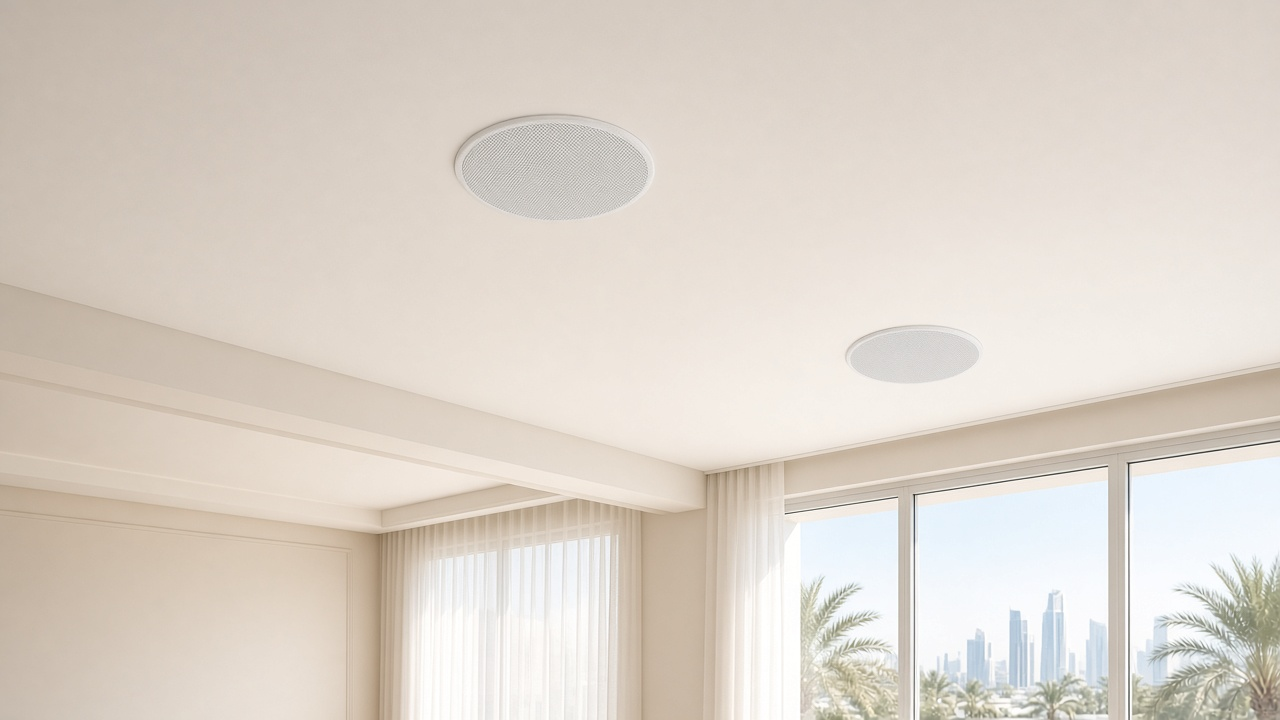
Swapping out old ceiling speakers seems straightforward until you pull one down. Both the Focal 100 ICW6 and 300 ICW6 use a 6.5-inch driver, which makes it tempting to assume either will fit the existing hole. They will not necessarily. The cut-outs are different sizes, the published depth numbers do not always agree with each other, and your amplifier still needs to be happy with the actual electrical load.
We offer and supply Focal. This guide uses those two models as examples to walk through the fit and load checks that matter in a real retrofit. It is not about plaster-over invisible speakers or soundbar comparisons; for those topics, see invisible speakers in Dubai and ceiling speakers versus soundbar. Broader Focal notes are in our Focal speaker knowledge base.
Key takeaways
- Both models use a 16.5 cm / 6.5-inch driver, but the cut-outs (the holes in the ceiling) are 184 mm for the 100 ICW6 and 216 mm for the 300 ICW6.
- Focal's own depth figures conflict across product pages and manuals. Do not design around a single headline void depth (the space you need behind the ceiling).
- Nominal impedance (the electrical load the amplifier sees) is 8 Ω on both, but the published minimum figures differ. How many speakers you connect, and how the amplifier is designed, still matter.
- The 100 ICW6-T is a 70/100 V transformer model (for a distributed speaker line). The “T” suffix is not a finish code.
- Guidance for humid rooms, such as kitchens and bathrooms, is not an outdoor or waterproof rating.
- Passive ceiling speakers need a suitable amplifier. A streamer (a box that sends music to the system) is not a power amp.
Same driver size, different holes
According to Focal's product pages and linked manuals:
| Spec | 100 ICW6 | 300 ICW6 |
|---|---|---|
| Driver | 16.5 cm Polyglass | 16.5 cm Flax |
| Cut-out | 184 mm | 216 mm |
| Permitted ceiling thickness | 8–40 mm | 5–30 mm |
| Nominal impedance | 8 Ω | 8 Ω |
| Minimum impedance | 7.3 Ω | 4.8 Ω |
| Recommended amp power | 25–100 W | 25–130 W |
Sources: 100 ICW6, 300 ICW6, the 100-series manual and the 300-series manual.
The recommended amplifier power range is manufacturer guidance. It is not a continuous handling rating, and it is not what you would run day to day.
Mounting hardware differs too. The 100 series uses rotating brackets described in its manual. The 300 series uses Focal's EQI frame with a quarter-turn assembly. EQI's "no tools" claim refers to the mounting and assembly mechanism itself. It does not mean a finished Dubai ceiling can be fitted without cutting, preparation, cable work or proper inspection.
Why mounting depth needs checking on site
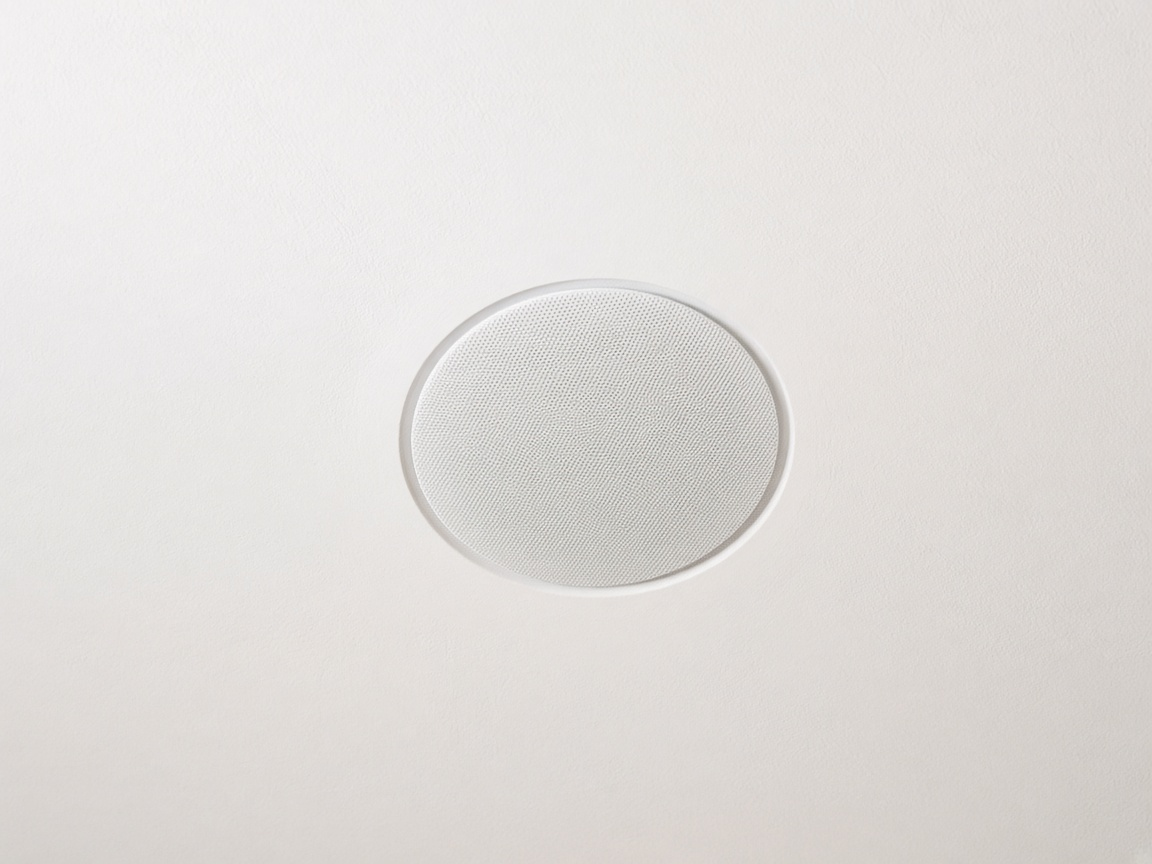
Depth is where retrofits go wrong, so it is worth being precise.
For the 300 ICW6, Focal's current product page lists depth at 105 mm and mounting depth at 3.94 in. The linked 300-series manual gives overall depth as 108 mm and depth behind the surface as 105 mm. Both documents were opened. Which figure applies to a given production revision is not settled here.
For the 100 ICW6, the website lists overall depth at 95 mm, while the manual states 91 mm behind the surface. Treat any published number as a starting point rather than a guaranteed minimum void.
Do not plan a retrofit around a single mounting-depth figure from an article like this one. Check the exact model's current spec sheet, the manufacturer template and the physical ceiling void, including space for cable bends and any obstructions. There is no unconditional "fits a 100 mm void" promise we can make in print.
Impedance, amplifiers and keeping old cable
Nominal 8 Ω does not mean impedance stays at 8 Ω under all conditions. The minimum figures in the table above show why parallel speaker counts and zone wiring still need checking against the amplifier you are actually using.
Keeping existing ceiling cable can be sensible once you have confirmed its condition, route, polarity and suitability for the intended amp and speaker set. No cable gauge, speakers-per-amp count or no-rewire guarantee can be established for an unknown villa.
A passive Focal ceiling speaker does not connect to WiFi. If the plan includes a streamer, keep the roles separate: the streamer feeds the system, and the power amplifier drives the speakers. We offer and supply WiiM among other options, and we are a Sonos dealer if that amplifier or system path suits the project better. Neither status turns a streamer into a speaker amp, and neither is a Focal authorised-dealer claim.
When app or streamer discovery is the weak link, an experience-led network walk-through can help; see wifi.hurst-first.com. That is not an RF heatmap survey, and it does not replace measuring the ceiling hole.
Humidity rooms are not outdoor speakers
The 100 ICW6 page attributes humidity resistance to its treated Polyglass cone. Both series manuals describe use in humid rooms such as kitchens and bathrooms. Neither passage establishes direct-shower, outdoor, salt-air or dust-proof approval.
If a project needs a 70/100 V distributed line, that is a different product entirely. The 100 ICW6-T includes a transformer. Do not treat it as electrically identical to the plain 8-ohm 100 ICW6, and do not mix an unspecified line-system speaker with an ordinary hi-fi amp by analogy.
Fire-rated back boxes appear as an option in the 100-series manual. That does not prove a particular Dubai ceiling assembly is compliant. There is no verified universal UAE fire-hood rule or Civil Defence approval in this guide. The responsible designer or contractor has to assess enclosures and penetrations for the actual ceiling.
Dubai retrofit realities
Occupied villas often come with existing holes, extra gypsum layers, ducts, cables and limited access. Inspect the space properly. Manufacturer manuals tell installers to check for obstructions and cables before cutting, and community names do not tell you the void depth.
Local catalogue listings for 100 ICW6 and 300 ICW6 exist in the UAE. A shop page shows the models are sold here, but it is not proof of our stock, delivery time or product-specific regional warranty, so we are not quoting retail prices.
For how zones and streaming fit a whole home, see whole-home audio in Dubai. For installation help, see our AV services.
If ceiling works overlap lighting controls on the same renovation, remember the trade boundary: we handle work related to the actuators; electricians do lighting installation, drivers and actuator power. That is not permission to assign all ceiling cutting or making-good to us.
Stereo, background or cinema
Ceiling positions that work for quiet background music in a corridor are not automatically right for a main listening pair, and cinema height or surround channels have their own aiming needs. Agree the job of each speaker before anyone enlarges a hole.
If the upgrade is part of a wider whole-home streaming plan, keep zone layout and amplifier channels on the same drawing as the cut-outs. Swapping grilles without checking load is how an old multi-room amp ends up unhappy with a lower minimum impedance.
No guaranteed acoustic improvement is claimed here. The point of the retrofit check is to avoid a speaker that does not fit, a void that is too shallow, or a load the amplifier cannot support.
A practical retrofit checklist
- Record the existing speaker model, actual hole size, visible grille and what you can learn about the void and obstructions.
- Confirm the exact proposed SKU and template, structural support, ceiling thickness and physical clearance. Do not infer fit from driver diameter.
- Identify the amplifier and zone layout and the real connected load.
- Agree whether the speakers are for stereo music, background zones or cinema channels. A position that works for one job is not automatically right for another.
- Coordinate cutting, making-good, any fire or acoustic assembly and system commissioning with the responsible trades.
DIY is reasonable when / Call us when
DIY is reasonable when you can measure the existing hole accurately, the new model's cut-out clearly matches, the void and thickness are already confirmed against the current spec sheet, and the amplifier load is straightforward.
Call us when you are moving between 100 and 300 series, the old hole size is unknown, depth documents disagree with what you can see in the ceiling, several speakers share one amp, or cutting and making-good need coordinating with other trades.
FAQ
Can I keep the existing ceiling holes?
Only after comparing the exact cut-out and template. A 6.5-inch driver does not mean a 6.5-inch hole, and 100 ICW6 and 300 ICW6 are not drop-in swaps for each other.
Can I keep my amplifier?
Check its supported load and zone wiring against the actual speakers, including published minimum impedance, not only the 8 Ω nominal figure.
How deep does the ceiling need to be?
Focal's published depth figures vary between product pages and manuals. Check the exact model's current spec sheet and the real void, including cable space. We cannot give a single guaranteed mounting depth in an article.
Are bathroom-rated models outdoor speakers?
No. Humid-room guidance is not an outdoor or environmental waterproof rating.
Is the 100 ICW6-T the same as the 100 ICW6?
No. The T version is built for 70/100 V line systems and is electrically different from the standard 8-ohm model.
Are you an authorised Focal dealer?
We offer and supply Focal. We do not claim authorised Focal dealer status here.
Talk to Hurst First
If you want to upgrade ceiling speakers without guessing the hole or the amplifier load, we can check the cut-out, the void and the system around them before anyone cuts plaster. We work on villas and apartments across Dubai.
There is no pressure. If you would like the retrofit checked against the exact Focal model you have in mind, Request a consultation and we will take it from there.