



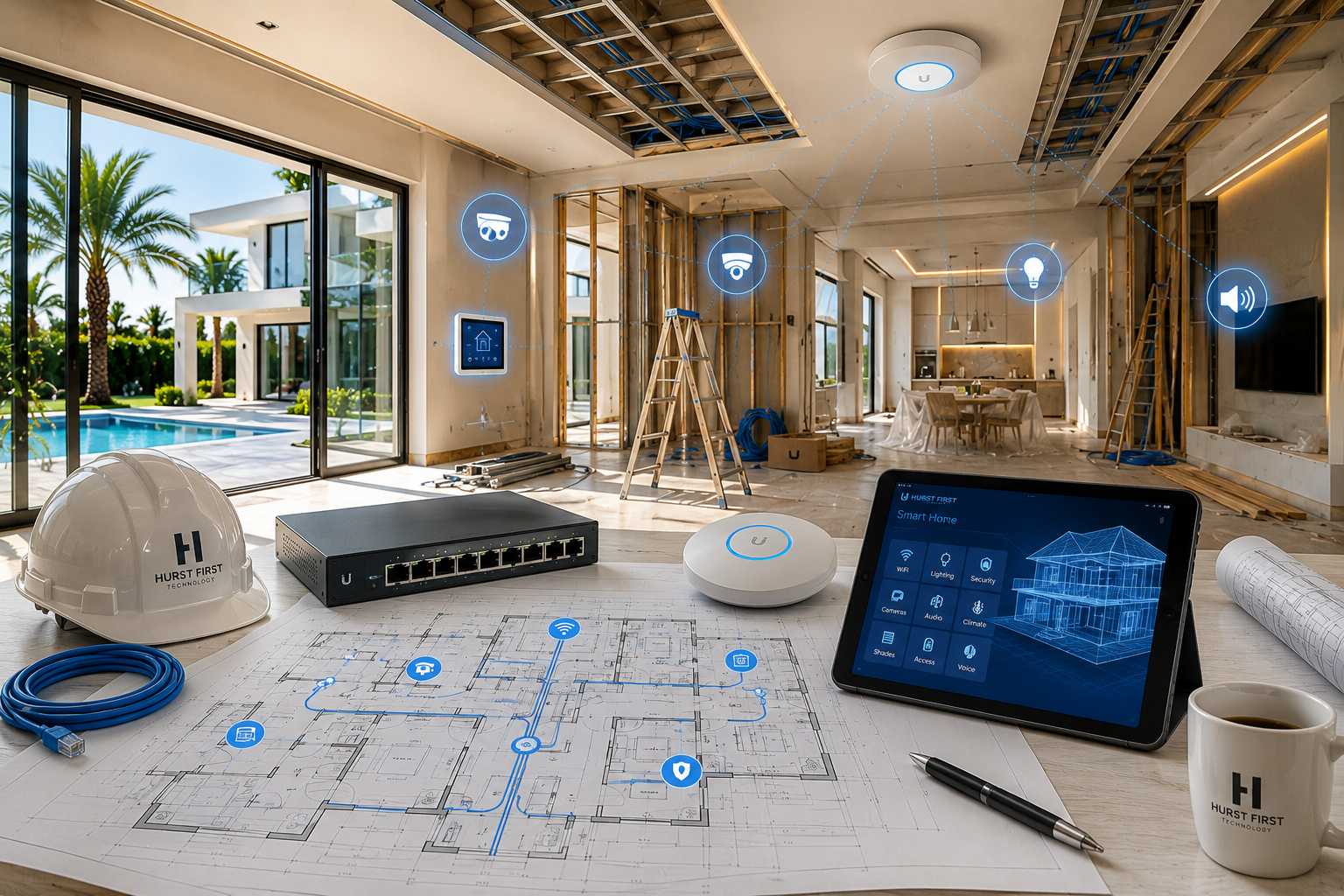
If you are already opening walls, don’t stop at paint and tiles. This is the time to make the house ready for the next 10 years, not just the next move-in date.
A lot of smart home problems in Dubai villas come from one simple mistake: the renovation is finished before the wiring plan is finished. Then people try to add cameras, Wi-Fi, sensors, shades, and controls later. That usually means visible cables, weak coverage, or expensive rework.
Start with the boring stuff: cables and conduits
The best smart home is the one with cables in the right places.
At minimum, plan for:
- Ethernet to every TV point
- Ethernet to ceiling AP locations
- Ethernet to the study or office
- Ethernet to TVs, video doorbells, and camera points where possible
- Spare conduits from the rack to key rooms
- Spare conduits to the garden, gate, and outdoor entertainment areas
In the UAE, I always tell people to oversize the conduit. It costs far less to do it now than to chase another line through finished walls later. If you think one conduit is enough, it probably isn’t.
Use proper structured cabling, ideally Cat6A if the budget allows. For most villas, Cat6 is still fine for now, but Cat6A gives you more headroom and is worth considering if the renovation is major.
Put the network rack in a sensible place
The rack should be out of sight, but not hidden away in a place that cooks in summer.
Good options are:
- a utility room
- a store room with ventilation
- a dedicated cupboard with power and cooling
Avoid cramped corners with no airflow. Dubai heat is not kind to network gear, and neither is dust. If you are planning a rack, think about:
- a clean power circuit
- surge protection
- UPS backup for router, switches, and controller
- ventilation or a small cooling strategy
- enough space to expand later
A small, neat rack is better than a large one that nobody can access.
Plan Wi-Fi around the layout, not the ceiling design
Wi-Fi should be designed with the villa layout in mind, not guessed after the plaster is done.
Access points work best when they are placed for coverage, not convenience. In a typical villa, that means planning ceiling locations early so each floor and the main living areas get proper coverage.
A few practical points:
- one AP in the living area does not cover a whole villa properly
- glass, concrete, and metal can all weaken signal
- master bedrooms, upstairs corridors, and home offices usually need their own coverage
- outdoor areas often need separate planning
If you are renovating in Dubai or anywhere in the UAE, assume the house will have a mix of thick walls and long indoor-to-outdoor runs. That changes the network design.
Think about the smart home system you actually want
Not every home needs a full automation platform. But if you do want one, decide early.
Before the walls close up, think about whether you want to control:
- lighting
- climate
- curtains or blinds
- gate and intercom
- cameras
- irrigation
- pool equipment
- audio zones
Each of these affects cabling, device locations, and sometimes power requirements. For example, motorised blinds need correct power and switch planning. Cameras need network points. Irrigation and pool control may need weatherproof enclosures and proper isolation.
The earlier this is decided, the cleaner the installation will be.
Leave room for the things you have not bought yet
This is where most renovations fall short.
People know what they are installing now. They rarely think about what they might want in two years.
Leave space for:
- extra switch ports
- spare rack units
- blank conduit runs
- additional camera points
- more APs if the family grows or the layout changes
- future EV charger or energy monitoring
- smart garden and outdoor lighting
You do not need to install everything now. You do need the infrastructure to add it later without breaking open finished walls.
Don’t forget the outdoor areas
In Dubai homes, the outdoor areas matter more than people think.
Gardens, terraces, pool decks, and majlis spaces all need their own planning if you want reliable Wi-Fi and smart control outside. Outdoor points should be wired and weather-rated properly. Don’t rely on indoor signal bleeding out through a wall and calling that “coverage”.
If the villa has a garden or pool area, plan for:
- outdoor Wi-Fi access points
- camera points at gates and perimeter areas
- lighting control for paths and seating areas
- irrigation controls
- power and network points for entertainment screens or speakers
Outdoor tech fails quickly when it is treated like indoor tech with a different label.
Common renovation mistakes to avoid
A few mistakes show up again and again:
- waiting until after tiling to think about wiring
- installing too few data points
- putting the network rack in a hot, dusty corner
- relying on mesh Wi-Fi everywhere instead of wired backhaul
- forgetting ceiling AP locations until after false ceilings are closed
- not planning for outdoor areas
- choosing devices before the infrastructure is ready
Most of these are avoidable if the builder, electrician, and smart home installer are aligned early.
A simple rule that saves money
If a cable, conduit, or mounting point is cheap to add now, add it now.
That is the whole game with renovation planning. You are not trying to make the house “smart” on day one. You are making it easy to upgrade without opening walls again.
For Dubai and UAE villas, that usually means:
- structured cabling first
- proper rack planning
- Wi-Fi designed on paper before ceiling work
- smart home decisions made before finishes
- space left for future expansion
Do that well, and the house will feel better from day one. More importantly, it will not age badly by year three.