



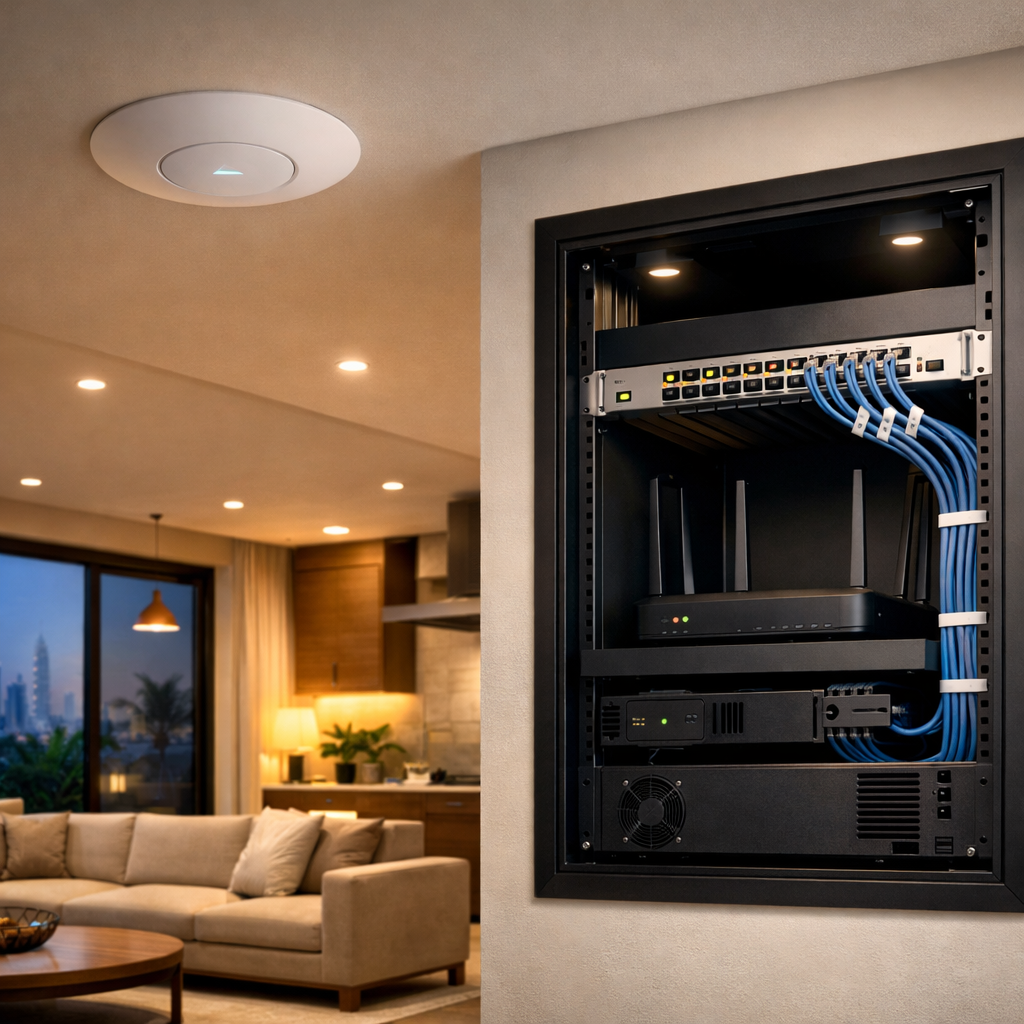
People ask for “mesh” a lot in Dubai because it sounds simple. One router, a couple of extra units, and the whole villa or apartment is covered. Sometimes that works. Sometimes it becomes a lot of expensive frustration.
Mesh is fine for small homes, quick retrofits, and places where you can’t pull cable. It is also easy to move around if you are renting. The trade-off is that every wireless hop costs something. In a concrete villa, or an apartment with thick walls and mirrors everywhere, that loss shows up fast.
Access points are the cleaner solution when you can do proper cabling. You place them where coverage is needed, feed them with Ethernet, and let them do one job: provide Wi-Fi. That usually means better roaming, better speed, and fewer random drops on calls or cameras.
The decision is pretty straightforward:
- Use mesh if cabling is impossible or temporary.
- Use access points if you want proper coverage and stability.
- Use both only when the layout really forces it.
In Dubai villas, access points usually win because the house is split across floors, majlis areas, garden rooms, and service spaces. Mesh nodes sitting in a hallway look tidy, but they often struggle once the signal has to cross a few walls.
In apartments, a single good access point can be enough. A lot of people buy three mesh units for a 1,200 sq ft flat when the real fix is moving the main unit out of the cabinet and placing one decent AP in the middle.
I also see people overdo it. More nodes are not automatically better. Too many radios in a small space can make roaming worse, not better.
So the rule of thumb is simple: if you can wire it, wire it. If you cannot, use mesh carefully and keep the hops to a minimum. The hardware should fit the building, not the other way around.