



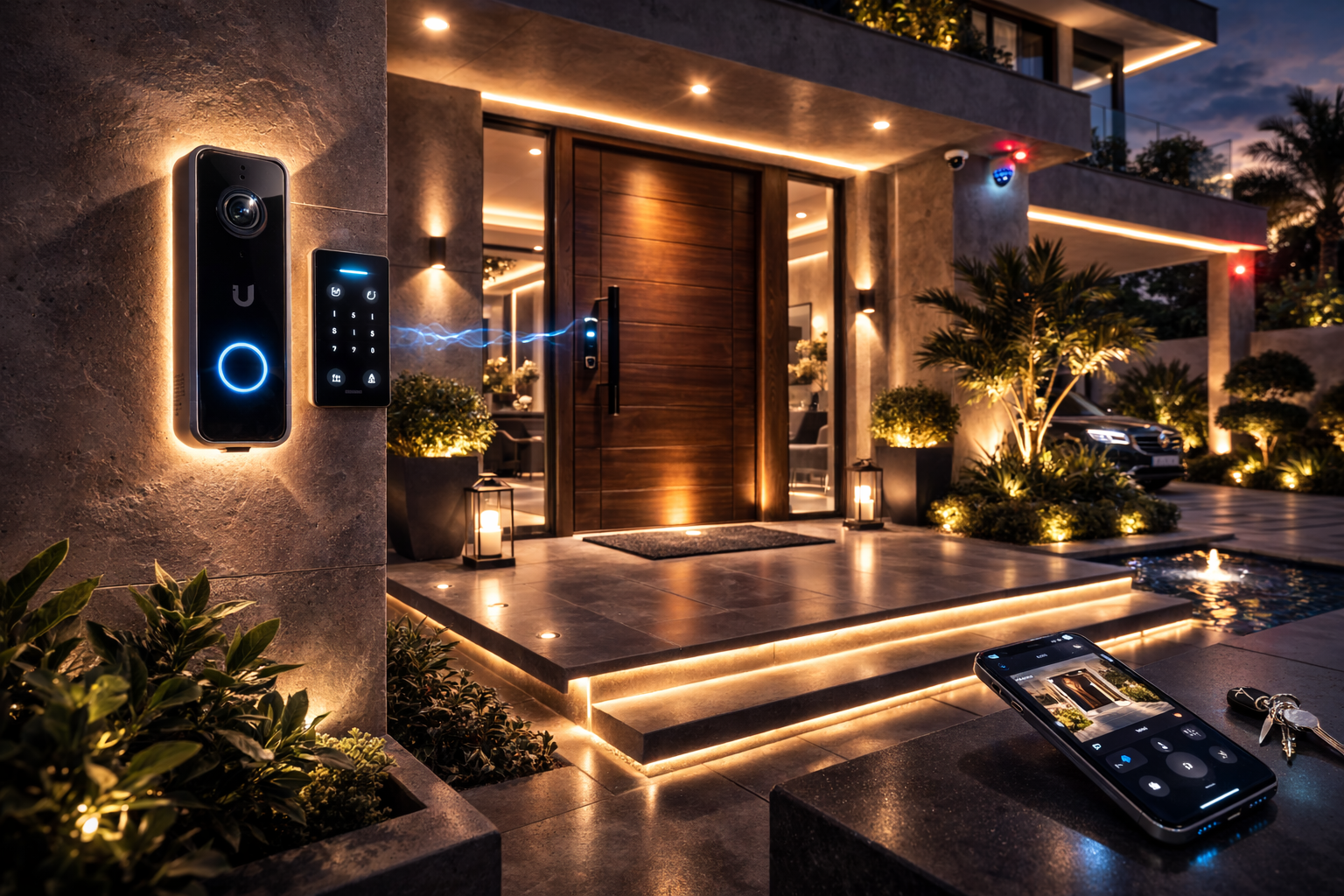
Most camera systems fail because the cameras are in the wrong places, not because the camera brand is bad.
In Dubai villas, the obvious mistake is mounting everything too high and calling it covered. That gives you a picture of the driveway and not much else. You can see that someone moved. You cannot tell who it was.
Good placement is about faces, approach paths, and usable coverage.
Start at the entrances
The front gate, front door, and side access points matter most.
If you only have budget for a few cameras, put them where people have to pass through:
- Main gate
- Pedestrian entry
- Front door
- Side gate or service entrance
- Rear access if the villa has one
A camera should catch a person before they reach the doorbell or lock, not after.
For larger villas, add coverage of the driveway and the path from gate to entrance. That gives you a proper sequence, which helps when you are checking incidents later.
Avoid the “too high” problem
A lot of installers mount cameras up under the eaves because it looks tidy.
It does look tidy. It also gives you a view of hats, shoulders, and car roofs.
If the camera is too high and too wide, it misses detail. If it is too low, it becomes easy to tamper with. The right height depends on the angle, but the goal is the same: enough detail to identify people and enough width to understand the scene.
On many villa facades, a slightly lower and more focused angle works better than a very high wide-angle shot.
Think about light and heat
Dubai changes camera performance more than people expect.
Strong sunlight can wash out a view. Dark entrances can hide a face. Reflections from glass, polished stone, or parked cars can reduce image quality. Heat also affects outdoor equipment and cabling.
That means you should check:
- Sun path across the front elevation
- Backlighting from the driveway or street
- Night vision range
- Whether the camera has enough protection from direct sun
- Cable route and PoE reliability
A camera pointed straight into bright afternoon light is not doing much for you.
Where to place the common cameras
A practical villa layout usually includes:
- One at the front gate looking inward
- One near the front door looking toward visitors
- One covering the driveway and vehicle entrance
- One on the side access or service area
- One at the rear garden or pool access if required
For larger plots, add cameras only where they solve a real problem. More cameras with bad angles are worse than fewer cameras placed properly.
Privacy matters too
A villa is not a warehouse. Do not cover the neighbour’s windows, public footpaths, or unnecessary parts of the street unless there is a clear reason and the layout allows it.
That keeps the system more useful and avoids awkward complaints later.
What people forget
The camera is only one part of the system.
You also need:
- Stable network connection
- Proper storage
- Backup power for the recorder or switch
- Clean cable runs
- A way to review footage quickly
- Admin access that is actually kept safe
If the recorder sits in a hot cupboard with no backup power, the system may look fine until the first outage.
Straight answer
Put cameras where people enter, not where they look nice on the fascia.
In Dubai villas, that usually means gates, doors, driveways, and side access points. Focus on faces, not just movement. That is the difference between a system that records and a system that helps.