



In the UAE, desert camps are often close enough to the city to feel accessible — but far enough that connectivity becomes unpredictable fast. Once you leave built-up areas around Dubai or Abu Dhabi, mobile coverage can go from “fine” to “unusable” with no warning. For hospitality operators and private camp owners, that creates a real problem: guests still expect WiFi, and the camp’s own systems (security, payments, monitoring) increasingly rely on a stable internet connection.
For desert camps, the historic options were limited:
- mobile routers (inconsistent, especially when the camp is busy on weekends)
- point-to-point links (possible in some locations, but requires infrastructure and line-of-sight planning)
- expensive enterprise satellite (high cost, complex installation)
Starlink changes the equation. It gives you an independent connection that can work in genuinely remote locations — as long as you design the setup properly.
This guide walks through what matters in a real desert camp installation: placement, power, environmental protection, and the internal network (the part most people get wrong).
The Challenge of Desert Internet (Why Camps Struggle)
There are three reasons desert camps struggle with connectivity:
-
Mobile signal is unreliable
Even if one network works in your area, performance can fluctuate based on congestion and tower conditions. Busy weekends make it worse. -
Fibre isn’t available
Most camps are outside standard fibre rollouts, so there’s no “simple upgrade path” like there is in a villa community. -
Traditional solutions are expensive or hard to maintain
Many solutions work on paper but fail operationally because they’re fragile, difficult to service, or too costly for what you get.
If you’re trying to run guest WiFi, a CCTV system, and remote monitoring, “good enough sometimes” is not good enough.
Why Starlink Works in the Desert (When It’s Installed Correctly)
Starlink is well suited for desert camps because it doesn’t rely on local infrastructure. In most cases, if you have:
- clear sky visibility
- stable power
- a properly designed internal network
…you can get reliable internet in places where 4G/5G is inconsistent or completely unavailable.
That makes it a strong option for:
- guest WiFi and lounge areas
- CCTV systems that need remote access
- remote monitoring and management (sensors, alarms, basic automation)
- operational needs (staff comms, payments, booking systems)
The key is to treat Starlink as the upstream connection — not as the entire solution.
Placement: Sky View Is Everything
In the desert, the biggest “obstructions” are usually not buildings — they’re camp structures and how the dish is positioned.
Common mistakes include placing the dish:
- behind a majlis structure or tent roofline
- near shade structures or decorative poles
- too low, where vehicles and people can block part of the sky
- close to dunes/berms that create a partial horizon obstruction
The goal is a wide, unobstructed sky view so satellite handoffs remain stable. A dish that “works most of the time” can still cause dropouts during important moments — video calls, CCTV playback, or a busy guest WiFi period.
Power Considerations (Stability Matters More Than People Think)
Power is the limiting factor in many desert installs.
Desert camps typically rely on:
- generators
- solar + battery systems
- mixed power distribution across multiple structures
Starlink needs stable power. If the power dips when another load starts (lighting, refrigeration, pumps), you can get:
- unexpected reboots
- connection drops
- inconsistent performance that looks like a “Starlink issue” but is actually power-related
Practical recommendations:
- use a stable power supply (not a low-quality extension run)
- consider basic surge protection
- ensure the dish/router power path is protected from “heavy load” circuits
If you’re serious about uptime, solve power first.
Mounting and Environmental Protection (Heat, Dust, Wind)
Dubai desert conditions are harsh on outdoor gear. You need to assume:
- high temperatures (especially summer afternoons)
- fine dust and sand everywhere
- wind that can shift poorly mounted equipment
- curious guests and staff moving equipment unintentionally
A proper Starlink mount should be:
- stable (no wobble, no slow rotation over time)
- safely out of the way (reduce accidental knocks and cable pulls)
- installed with cable protection in mind (avoid exposed, tripping, or heat-damaged runs)
Dust and heat don’t just affect the dish — they also affect connectors, power supplies, and any “temporary” cabling people use to get online quickly. Do it cleanly once, and you avoid a lot of ongoing headaches.
Network Setup (Important): Starlink Alone Is Not Enough
This is where most desert camps go wrong.
Starlink gives you internet. It does not automatically give you good WiFi coverage across a camp. Real camps have:
- multiple buildings or zones (majlis, guest tents, staff areas)
- outdoor seating and pathways
- thick walls in some structures
- distances that exceed what a single router can cover reliably
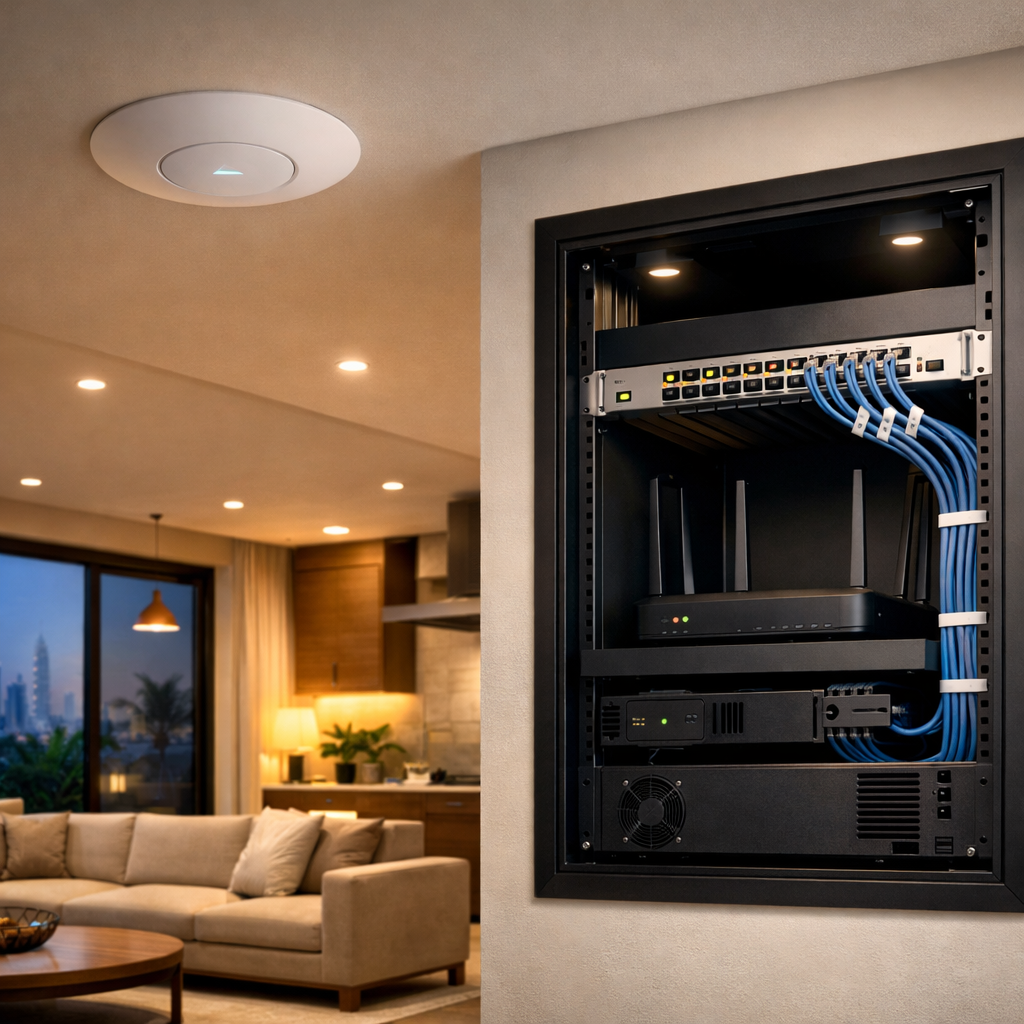
A proper camp network typically needs:
- a router/firewall for stability and control
- multiple access points positioned based on camp layout
- a wired or point-to-point backbone between zones
- optional segmentation (guest WiFi vs staff vs security equipment)
If you rely on the basic Starlink WiFi, you’ll end up with complaints like:
- “Starlink is slow” (actually WiFi coverage is weak)
- “internet drops in the tents” (actually the router is too far away)
- “CCTV keeps disconnecting” (actually there’s no stable network design)
Real-World Use Cases (Where This Setup Pays Off)
Starlink is particularly useful for:
- luxury desert camps with guest WiFi expectations
- private farmhouses and remote majlis setups
- remote hospitality where operational systems need connectivity
- security-heavy sites where CCTV monitoring and remote access matters
In these cases, the benefit isn’t just “having internet.” It’s having a predictable connection that your operations can rely on.
Frequently Asked Questions
Does Starlink work anywhere in the desert?
In most cases, yes — as long as there’s a clear sky view and stable power. The desert is generally a favourable environment because there are fewer tall obstructions, but placement still matters.
Is Starlink enough for a full camp WiFi network?
Starlink is the internet source. For a camp-wide WiFi experience, you still need a proper network design with access points and a backbone between zones.
Can Starlink support CCTV and remote monitoring?
Yes — if the internal network is stable and power is consistent. CCTV reliability is usually a network and power issue more than a raw “internet speed” issue.
Need Help?
For full setups including WiFi and CCTV, see our WiFi services and security solutions.
Also read: Starlink in the UAE